Urban Orchard's Overlapping Economic Benefits
Improved health. Flood resilience. Economic development. Like many well-designed park projects, Urban Orchard, situated just outside the city of Los Angeles, provides a number of synergistic benefits to its community.
By Lisa W. Foderaro
Published May 19, 2026



The seven-acre park recently took root in South Gate, whose 93,000 residents formerly had little access to green space. Just three percent of the city’s land area is composed of parkland, about one fifth of the national average.
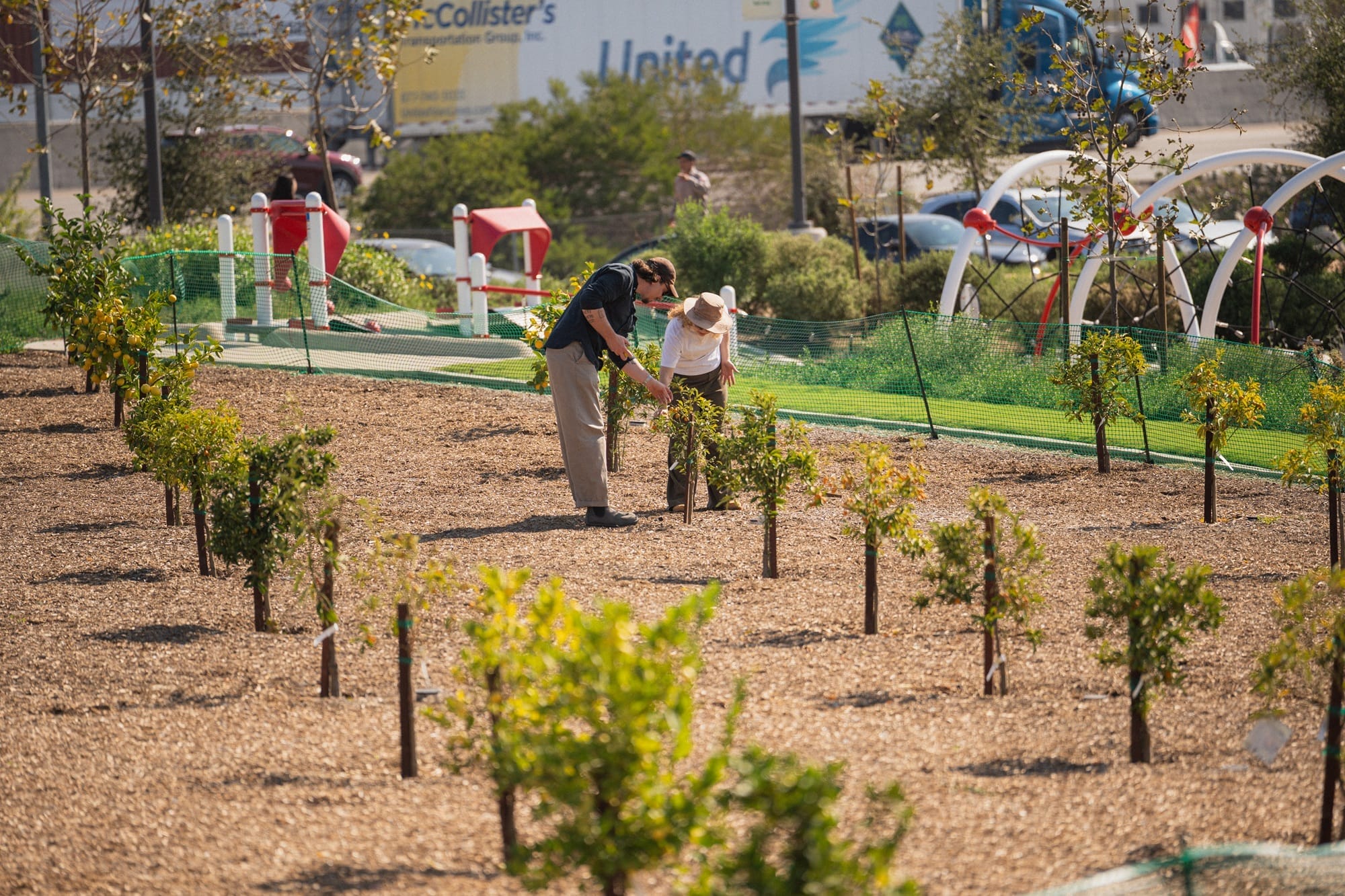
But Urban Orchard provides more than an infusion of park space for residents, 95 percent of whom are Latino. As its name suggests, the park contains an orchard with a grove of 200 fruit trees, including lemons, limes, oranges and kumquats, that the public can pick and take home. In addition, a foot path and fitness zone, with outdoor strength-training equipment, provide parkgoers with a free outlet for exercise.
For the city government, Urban Orchard delivers a potent mechanism for cleaning stormwater that flows past the park. The cleansed water is used to irrigate the fruit trees and other native plants, which saves money on freshwater resources. The park features a highly engineered water filtration system that captures the water that runs through an adjacent channel, a tributary of the nearby Los Angeles River. That channel gathers runoff and rainwater from a wide region before connecting to the river and flowing to the ocean.
Before it can slosh into the L.A. River, however, the gray water is funneled into Urban Orchard. There, it enters a subterranean “hydroponic separator” (like a huge salad spinner) where trash is taken out. The water then moves through filters and two wetlands before it is ready to irrigate the park. Although the waterworks was the most expensive part of the park, it also provides the biggest bang for the buck.
Finally, a workforce development program is on site, giving young people a springboard into the competitive job market. The program is run by the Conservation Corps of Long Beach (CCLB), a nonprofit that helps maintain the park. CCLB assigns several of its members to Urban Orchard, where they are paid to weed, pick up litter and monitor the wetlands. Dan Knapp, CCLB’s executive director, hopes members can learn the more sophisticated aspects of the filtration system as well.
“Urban Orchard offers a native landscape, urban agriculture, and an engineered wetlands,” Knapp points out. “The city gets the operations and maintenance services at a reduced cost, and we can use the park as a platform for all of this invaluable training.”
Lisa W. Foderaro is a senior writer and researcher for Trust for Public Land. Previously, she was a reporter for The New York Times, where she covered parks and the environment.

Donate to become a member, and you’ll receive a subscription to Land&People magazine, our biannual publication featuring exclusive, inspiring stories about our work connecting everyone to the outdoors.
